


Hyvä CMS issues and possible native solutions
Discover the challenges faced by Magento 2 frontend and the rise of Hyvä Theme with AlpineJs and TailwindCSS. Learn how to efficiently manage CMS conten...
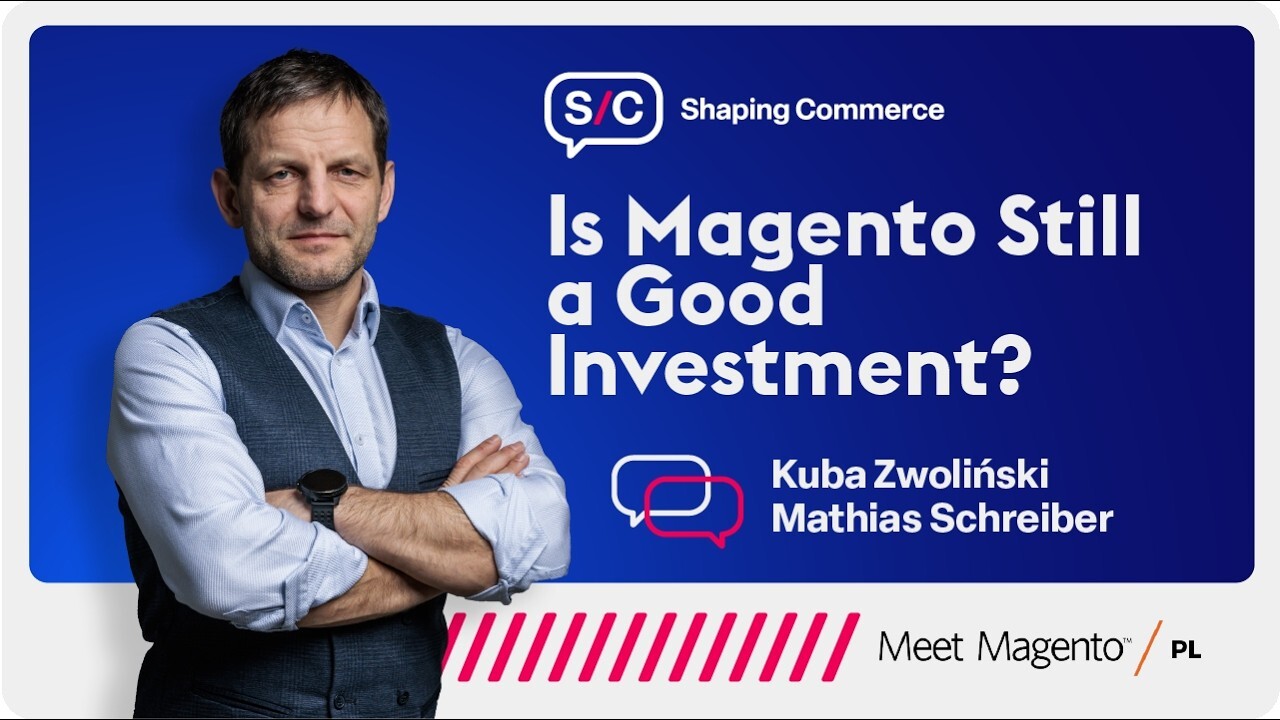
"This is still a good investment? I don't think so. This is honest and this is real and you can have like proper deep conversation. Do we need more features? Maybe it's just about polishing what we already have. It would be great if we could drastically simplify installing Magento 2. I've seen events in on pretty much any continent by now over the course of this year. Everybody has the same feedback: the frontend was, it's just dated."
- Mathias Schreiber, Executive Director of the Magento Association
[music] [music]
Kuba Zwoliński (Shaping Commerce): Mathias, I'm really happy to have you here at Meet Magento Poland. Thank you. And especially that I believe that it's a pretty busy time with many events around the world.
Mathias Schreiber (Magento Association): Autumn is packed, yeah. There's like five events in three weeks, I think, all around the globe. That's the tricky part.
Kuba Zwoliński: And I think that this is a time investment for everyone. It's really not about the conference tickets, but the time we spend here is an investment. And when traveling around different events, what feedback do you have? Is it that this is still a good investment, or maybe in-person events are a matter of the past?
Mathias Schreiber: I don't think so. There was this vibe during the whole pandemic kind of thing—"Oh, we can do everything remotely"—but I think that, that in-person events where you randomly bump into people, that's the magic to it. This whole idea of doing something online—people have something in their calendar and they have to show up for a reason. But half the conversations I've been having out there, it's just me randomly bumping into people and sparking nice conversations, getting to know people. And I think this is where the social interaction really comes from. So it's not this fake like Instagram bullshit where you just go, "Oh, I'm very social, look at me," right? But, here it's like, this is honest and this is real and you can have proper deep conversation. So I don't see in-person events going away anytime soon.
Kuba Zwoliński: I'm happy to hear that because I see the same at Meet Magento Poland. That, of course, there was a problem of no offline events, no in-person events, and we were trying different formats like online ones, but it didn't really work. It was just another webinar. So, after the pandemic, when we brought back in-person events, I can see that they are growing again. So it's interesting, and it's good to hear that it might be even a global thing.
Mathias Schreiber: Absolutely. I mean, I've seen events on pretty much any continent by now over the course of this year. Everybody has the same feedback. There's more Meet Magento events coming up right now. So we have applications from Finland, from Egypt, from Bangladesh, Dubai, Canada was a first this year, for example. So, it's more events happening because I think that—and this might sound a little bit esoterical—but people do have a desire for those connections. So I don't believe that, like I said, it's just another webinar. And it also loses its value, I think. It's because, yes, it's one thing in my calendar for, I don't know, two hours or something, and then maybe you attend, maybe you don't, maybe you jump out of a session. But right here, everybody wants to stay in that circle and stay connected. So this is, I think, very human.
Kuba Zwoliński: Yeah, like, we had quite a journey trying to figure out who is our audience at Meet Magento Poland because we started, as every Meet Magento, having different tracks for business and for technology. But after years, it looks like it was—the idea was okay, but it was missing some details. And I think that what we have right now, it may be a good direction because it's for business and for developers, but the business part are just developers and tech people from the business, from e-commerce, yeah.
Mathias Schreiber: I mean, it's a tech conference after all, isn't it?
Kuba Zwoliński: Exactly. So, so I think that was very good for Meet Magento to maybe identify itself that we are a tech conference. We don't try to be a business conference—a typical business, marketing, sales conference. We focus on a technology platform. But do you think this is also a way for other events around the world?
Mathias Schreiber: Well, I think you always need one, maybe two reasons, or like, columns—center columns—for a reason for a person to come here, right? So in our case, it's—one could argue that it's e-commerce—but it's more, more precise than that. It's about the Magento ecosystem in a whole. That's what brings people here. If you do an event about—I don't know many events about sports in general, maybe Olympics, okay, I get it, right? But other than that, any conference that you attend has some like center column around it, whether it's cars or boats or, I don't know, growing plants, you know. It's always this center column that you have where the circle of people originates from. And I think for us, that's what brings people in.
Kuba Zwoliński: We have those people here, so we give them a platform space for sharing knowledge, for discussions. But what do you think we should ask them for? Because after all, it's a community project, it's open source. So how can we get something from our attendees here?
Mathias Schreiber: Well, I mean, asking for feedback, that's like the obvious one, which, interestingly enough, very few organizers do at the beginning of the opening of the whole conference like you did, which is actually, I think, smart—that you encourage people to, "Hey, share your feedback, what you would like to see." A lot of it, I think, will also come organically. So people see a speaker on stage and say, "Well, I might have something to share with people too," and that might just encourage and empower them to think that way. And that's what I like about in-person conferences too, because people can see that it's not all shiny bells and whistles. Something goes wrong with the slides—like my slides were too bright this morning, definitely. So I need to tone down on the signal orange.
Kuba Zwoliński: You were just enlightening everyone.
Mathias Schreiber: Yes, that was, that's the story that we're going tell from now on, right? You know, things like that. But I think that actually seeing people on stage and seeing the real, not polished version of it, it's like more raw. It's closer to how people feel. I think sessions like these encourage people to go on stage and speak. It's also what I really like about this event in particular—is that the stage is not a separation between people, but it's more like an, like an extension of the audience, because you don't have like five meters between the first seat in the row and then up to the stage. Because that creates like an artificial barrier. I like it when it's more cozy, and I think that this takes away a lot of the—how would you phrase that?—a lot of the concern, or maybe fear, that people have going on stage. But this is such a family-type environment kind of thing, you know? It's—I don't want to overstress the word "safe" because it's overused in a different context—but this is for me just the right size of things.
Kuba Zwoliński: Yeah, I agree. I also like it. It's like, at some point, we wanted to grow to make it a huge conference for thousands of people. But, at some point, I realized that the quality of the industry professionals, and somehow localized approach—it's a great thing. So it's good to hear that you like it because it's like a setup coming more from a meetup, that people are more laid-back, more relaxed. There is a less formal atmosphere.
But I also wanted to ask—because, for a long time, the big, I would say, movement in the community was organizing hackathons—we don't see them that often anymore. So, how we can encourage people? Because I think that, you know, that drives this kind of innovation.
Mathias Schreiber: Yep, I completely agree. We are having a conversation set up a meeting with the people within Adobe to—how can we make this happen so the hackathons are worthwhile, you know? So that we can actually get stuff merged, because coding away is fun, getting it merged is more fun. And there's a couple of things we need to work through legally on Adobe's end. It's a big company, so we cannot just like, by the end of the hackathon, get 20 features merged. You know, that's the part that makes it tricky.
But, I do know that Adobe's engineering team is actively reaching out to us and going like, "Okay, so but how can we make it happen? Like, what would we need to do?" And then we say, "Ideally we want this," so we play like the Christmas market wish list. And then they go back to legal and say, "Well, you can have that and that, but you can't have that." And then we kind of work around this. And other than that, it's just a little bit of logistics, I would say.
I have this plan roughly put together with [name] from Adobe to do a one-week hackathon thing in the Austin offices. That's actually something Adobe came up with and said like, "Hey, why don't we do this?" So, now it's a logistical challenge. How do I get, I don't know, 50 people put on a plane, get paid for all these things? We can use the offices there, that's awesome. But getting 50 people from around the globe to Austin at the same day....
Kuba Zwoliński: Yeah, maybe this is the way to go. Like, we've imagined to have a different Imagine [event] in the US and different Imagine [evnets] in Europe—it's nice to have one global event but, after all, it's pretty challenging—the cultures are wildly different.
Mathias Schreiber: Yes, so events in the US are wildly different—much less "good friends" style like over here in Europe, for example. India is just huge—1,000 people. That's what Vijay is aiming for this year. He had like, I think he had 800 two years ago, and this year was a little bit less, but that's because they swap in between locations and the Magento headquarters of India is Ahmedabad, so he will be going back to Ahmedabad at the beginning of the year, and he expects to go for a thousand people, and that's wildly different.
Kuba Zwoliński: Okay. And coming back to—Meet Magento was one of the foundations of the Magento Association. So, how can we help to contribute to the Magento Association that actually drives development of Magento Open Source?
Mathias Schreiber: Well, I would slightly rephrase that. So, I don't care that much about contributing to the Magento Association. I rather care about contributing to Magento, where the Magento Association is just this structural vessel that we need to pay invoices and such. But to me, it's mainly about contributing and driving forward Magento as a whole.
So, there's very, very simple things like—I, we all know how algorithms work in social media. So the easiest way to push Magento past where it is right now is liking posts on LinkedIn, and commenting, the hands-up emoji, right? That's all the algorithm cares about and I think if we had—I mean, I don't know how many people are involved in Magento globally, let's say 100 thousand, maybe more, say hard to say, but I doubt it's only 2,000, right? But if every person would just—if we announced something new on Magento Open Source like the merchant docs, for example—if that post would get 2,000 likes on LinkedIn, it would just go through the roof. And that way we could expand that circle. So that's like the easiest way to contribute. Then, of course, we have the code contribution on the other end of the spectrum, which...
Kuba Zwoliński: And actually, I heard that the process was simplified, that code contribution is...
Mathias Schreiber: Yeah, we're working on that constantly. So, we have a 12-person team that's just working together with Adobe on how can we make the process simpler, because it has to be complicated because of legal requirements. And these are—this also, often the term "legal requirement"—I use it quite often—but there's a difference between something, let's say, that Adobe wants and something that Adobe has to follow by law. Both legal things, but it's different.
And there's a couple of things where Adobe has to follow through by law, they cannot change. And then there's a couple of things that are part of their enterprise workflow, which are hard to change but not immutable. We're now working to get like merge permissions, which is a huge sign of trust from Adobe's end towards that specific group. And yes, Magento Association helps facilitate that, but that's not a Magento Association thing. We just make sure that we have someone from the board be part of that team—not the head of that team, but just part of that team—so there's someone who can answer to Adobe in case something should go wrong. Because that's something you...
Kuba Zwoliński: Do you think it—maybe this is one of the first steps, that we make a circle and right now, Magento Open Source, that created a base foundation for Adobe Commerce is right now blazing its own trail again, that is going slightly in a different direction, being more independent?
Mathias Schreiber: Well, it's—there are those chances that that happens. However, I just try to be closely related to what Adobe's building anyways, because that seems to be like the most feasible solution. Going off in a totally different direction—I'm not sure whether that will actually happen, because the Magento core deliverable is quite well defined. There's things that Adobe's—that both Adobe and Magento are really, really good at, and then there's things that it's not so great for.
So if I have a, I don't know, an online store with, I don't know, 15 products, Magento? Nah, I don't know if that's like the perfect choice for it. But if you have a lot of SKUs and complex requirements with external systems involved, Magento is still the thing to do, right? And that's exactly the same market that Adobe is targeting anyways, so I think we're closely aligned to that. And in an ideal scenario, I would just like to have like our own community repository where we can merge whatever we want.
Kuba Zwoliński: Yeah, because there's actually a chance for new features. We know that Magento Open Source is not really planned to have new features right now.
Mathias Schreiber: Well, that's not exactly true. The thing is that—so we do have a defined workflow together with Adobe, because that—there's one scenario in which Adobe could like block a new piece of functionality, and this is if that piece of functionality would interfere with their internal product plans. But we identified that early on, so whenever somebody walks up and says, "Hey, I have a great idea for a piece of functionality," we have a weekly call with the product team from Adobe and just say, "Hey look, these are the things we have, someone wants to build this, does this interfere with anything or are we like in the clear?" Because we don't want a contributor to waste their time on something, right? So, we just don't have that many people that are willing to pick up such tasks up until now, but it's definitely possible.
Kuba Zwoliński: I also asked that question because I started to have some kind of a controversial opinion: do we really need new features there? Because when we look back at the origin of Magento 1 and what we have right now with Magento 2, there are some differences in architecture—there are. But in general, the features that were incorporated at the very beginning of Magento 1, they are with us, and this is a solid base for e-commerce. And the big question is, do we need more features? Maybe it's just about polishing what we already have.
Mathias Schreiber: And this is something that—I told somebody at a certain point, like, I consider Magento feature-complete—just the way how they're implemented. Of course, you can always polish stuff but there's also—there hasn't been like a groundbreaking change in planes for the last 60 years. And the planes get polished and they get better over time, and they're always a little bit more efficient, and a little bit more room, and the windows get bigger, but it's still a plane. It has wings, it has like jet engines and a cockpit in front.
Kuba Zwoliński: Exactly. Most of the promotions—that's all the same, and having a solid base for that it's is all we need. On the other hand, it's always good for marketing to say that there are tons of new features coming.
Mathias Schreiber: Yeah, but that's just how you tell the story, isn't it? Right? So, if we take a look at what Hyvä Commerce is doing, for example, they are not reinventing content management; they're just iterating on Page Builder, which is good, right? Perfect. Then that's something that should be done. Or what I would like to see—I have a content management background so I'm very passionate about content management—I would like Magento to automatically re-render image sizes, right? So it doesn't matter what kind of image size a merchant uploads, it should be something feasible for the website. That should be in core. Is it a new feature? Depends on how you sell it. I mean, you can upload photos now, you can upload photos later, but sure, it's just polishing.
Kuba Zwoliński: But when we are talking about Hyvä Commerce, you know that we are right after their announcement of fully open-sourcing the base Hyvä theme. Hyvä theme is exciting, as you know. They got a huge user base, and I have to say that Hyvä new architecture reopened Magento development for many companies.
Mathias Schreiber: Absolutely.
Kuba Zwoliński: So do you think that as an association you can support a bigger adoption of Hyvä theme as a base for new builds?
Mathias Schreiber: Personally, I wouldn't have open-sourced it; I would have merged it into core.
Kuba Zwoliński: Oh, that was my another question, because we know that how much we love Magento, it doesn't matter. We know that the frontend was just . . .
Mathias Schreiber: Just dated.
Kuba Zwoliński: Just a thing that we should at some point forget and we need a new frontend. But is there any talk towards that—that Hyvä Open Source could become, well, part of the main distribution?
Mathias Schreiber: Well, I didn't have the time to dive into the details of it. If I understood it correctly, you still need a license to make it work. And I—even though I disagree with how it works—I completely understand why you would still require a license, so that (a) your intellectual property—and that's the work that the Hyvä team has put in and this, we have to give them credit for that, absolutely. And at—on the other end, it's a good connection to potential customers, so I completely get why they're doing it.
Personally, yes, I think that Luma has had its time, but today is not that time anymore. You know, that the ecosystem has changed, web technology has changed, so yes, that would be—actually, I mean, that's a controversial thought, right? Ideally, a great new feature would be to have a proper modern frontend stack. But then people would say...
Kuba Zwoliński: Shipped out of the box.
Mathias Schreiber: Exactly. But once you propose that, people could say, "Oh, you're trying to kill Hyvä." No, I don't. All I'm stating is that the current frontend stack is dated and needs an overhaul. And, that's the tricky part.
Kuba Zwoliński: So there's always a question if we should reinvent the wheel, or maybe take something like open-sourced already if it's possible from the licensing perspective.
Mathias Schreiber: Ideally, yeah. In the sense of contribution, using something that's open source and get it merged into core, that would be good. On the other hand, I do know that the Hyvä team is doing a tremendous amount of work at putting it into fixes still to themes, and having that as a complication to contribution—because then we go into the Adobe process world, which is just slower than the Hyvä team is working, or slower than MOS is working right now because of those hurdles and hoops you have to jump through.
So ideally, it would be part of core. However, that comes with its own downsides. And I would like to—and this is something I want to do in December—and see if we can have Hyvä become the default frontend theme for Magento—when you just download Magento, but we bundle it together. So, the Hyvä team can just continue at their own pace, which is amazing pace, we all know that, but we can still have the experience for a new developer trying out Magento for the very first time be good, right?
I mean, these are things—for example, it would be great if we could drastically simplify installing Magento 2.
Kuba Zwoliński: Oh, yeah, that's a good point.
Mathias Schreiber: Right? Because what you do, everybody expects, "Oh, I just do a composer create-project and here we go." But no, you need a marketplace key, and no, you need a marketplace account, and, "Oh, the link is broken." You know, these are things we should fix.
Kuba Zwoliński: Yeah, one of the biggest changes from Magento 1, that was way simpler. And, as we are recording this. . .
Mathias Schreiber: This is going on TV? [laughter]
Kuba Zwoliński: . . . we are getting ready for the discussion panel about advantages of open source in the time of SaaS. So I do believe that open source and AI are a great match.
So, at Magento Association, do you already plan some groups, task forces, or activities that can simplify deployments, code generation, everything around Magento development with some kind of automation with AI?
Mathias Schreiber: We don't have concrete plans around this. What we are working on is—I'm putting together a hosting consortium kind of thing where I want people to define a set of rules or guidelines that several hosting companies want to adhere to, because we had conversations with quite a lot of merchants. They—something didn't work out with the previous hosting company, they wanted to change, and suddenly they're at the mercy of the hosters. And the hoster then makes everything super complicated just to squeeze out like another quarter of revenue, you know those things. And, acting up on that, I just had a conversation with a couple of hosting companies and said, "Hey, can we just come up with a couple of guidelines basically saying like, 'Hey, don't be a prick,' right?" So, and then we have several levels of that.
So how easy do you make it to move from one hosting company to another? How easy do we do with merging data or copying data over from A to B?—those kind of things just to solve a real-world issue for merchants. The whole AI train is tricky, because self-hosted AI models are not so common with hosting companies. Then there's, of course, the conflict of interest with Adobe, so I don't see Magento Association putting up a paid AI service Magento-related.
Kuba Zwoliński: Yeah, it was—when I was asking that question, it was more how AI different models can actually speed up working with Magento, not as a dedicated service, but more like the automation is a way to make open source even more affordable, cheaper in development. It's like, that's more how existing automation tools can help. We can leave that question open.
Mathias Schreiber: That's—I think so. That's what a broader discussion—and actually, we should join the panel that is starting right now and listen to what opinions our guests on stage have.
Kuba Zwoliński: We could do that, but yes, thank you very much for being here at Meet Magento Poland and for being here with me.
Mathias Schreiber: So, thanks, thanks a lot for having me.
Discover the challenges faced by Magento 2 frontend and the rise of Hyvä Theme with AlpineJs and TailwindCSS. Learn how to efficiently manage CMS conten...

Discover the latest advancements in e-commerce technology that are reshaping the industry. From the transformative Mage-OS, an open-source platform empo...

Picking how your online store looks and works in Magento or Adobe Commerce is a big deal. It affects how much it costs to build your store and how much ...